Exploration about the impact of computing technologies, these types of as synthetic intelligence (AI), on society relies heavily upon the money aid of the pretty providers that deliver all those systems. Organizations like Google, Microsoft, and IBM shell out millions of dollars each and every calendar year to sponsor labs, professorships, PhD courses, and conferences in fields like personal computer science (CS) and AI ethics at some of the world’s leading institutions. Business is the most important customer of academic CS investigate, and 84% of CS professors acquire at minimum some marketplace funding. All of these variables add to the important influence tech firms wield around the kinds of queries that are and are not requested about their merchandise, and which facts is and isn’t manufactured offered about their social affect.
As consciousness about these conflicts of desire builds, we are viewing developing phone calls from students in and all around CS to disentangle the self-discipline from Big Tech’s corporate agenda. However, specified the extent to which a lot of CS academia relies on funding from key tech organizations, this is a great deal less difficult mentioned than finished. As I argue below, a extra achievable nonetheless useful intention could be to introduce better safeguards in areas like conferences to mitigate undue company affect over important investigate.
I will make my scenario in two sections. Very first, in today’s article, I will:
- Give a rapid overview of discourse with regards to Massive Tech’s dominance in CS study, and
- Use a dataset I have compiled to illustrate the extent to which conferences—an critical arena for information sharing in the industry of laptop or computer science—are economically reliant upon some of the world’s most impressive technology firms.
In my second submit, I will observe up with my recommendations for actions that can be taken to lessen the opportunity chilling or agenda-placing consequences brought on by company funding on CS investigate.
A brief survey of issues about Big Tech’s influence
Relying on massive companies and the resources they control can develop considerable limits for the sorts of CS investigate that are proposed, funded and published. The tech field plays a massive hand in deciding what is and isn’t deserving of assessment, or how issues are framed. For instance, a tech enterprise might have a very distinct definition of privateness from that which is utilized by consumer legal rights advocates. But if the organization is pinpointing the parameters for the varieties of analysis it wishes to sponsor, it can pick to fund proposals that align with or uphold its own interpretation.
The scope of what is sensible to examine is hence shaped by what is of worth to tech corporations. There is very little incentive for these businesses to fund tutorial investigation about concerns that they take into account much more marginal or which do not relate to their priorities.
A 2020 study on synthetic intelligence exploration uncovered that “with regard to AI, corporations have elevated corporate study considerably,” in the form of both of those enterprise-amount publications as perfectly as collaborations with elite universities. This craze was illustrated in an investigation by Birhane et al. of best-cited papers revealed at premier equipment finding out conferences, which revealed “substantive and growing corporate presence” in that research. In 2018-19, nearly 80% of the annotated papers experienced some type of corporate ties, by both writer affiliation or funding. Also, the evaluation discovered that corporate existence is additional pronounced in the convention papers that conclusion up acquiring the most citations.
Birhane et al. produce, “the prime mentioned values of ML… this sort of as efficiency, generalization, and efficiency may perhaps not only enable and facilitate the realization of Significant Tech’s targets, but also suppress values these kinds of as beneficence, justice, and inclusion.”
One of the most vocal critics of Significant Tech’s “capture” of CS academia is Meredith Whittaker, a former Google personnel-turned Senior Advisor on AI at the Federal Trade Fee. She argues that tech organizations, hoping to muffle critics and fend off mounting regulatory pressure, are eager to form the narrative all around their technologies’ social impact by funding favorable exploration. This has led to popular company sponsorship of labs, college positions, graduate plans, and conferences—all of which are reliant on these organizations for not only funding, but normally also accessibility to info and computing means. This market capture of tech research—wherein organizations are strategically funding investigation or community strategies in a way that serves their have agenda—has been explained by scholars like Thao Phan et al. as “philanthrocapitalism.”
Furthermore, as Whittaker argues, the tech industry’s dominance in CS analysis “threatens to deprive frontline communities, policymakers, and the public of important knowledge about the charges and repercussions of AI and the business accountable for it—right at the time that this work is most needed.” Recognizing this danger, other ex-Googlers like Timnit Gebru and Alex Hanna have taken the initiative to launch the Distributed AI Analysis Institute, in an exertion to generate area for “independent, group-rooted AI research absolutely free from Massive Tech’s pervasive impact.”
I do wish to make crystal clear that acquiring funding from an business that does not completely align with one’s values does not automatically necessarily mean one’s study is compromised. Company funding of AI investigation is not inherently terrible, and teachers who do not accept Big Tech cash can continue to generate ethically questionable research. Furthermore, people today who take Significant Tech funding can nevertheless be significant of the corporations’ goods and their influence on society.
Even so, I concur with teachers like Moshe Y. Vardi who argue that we ought to grapple with the contradictions inherent in accepting funding for investigation this kind of as AI ethics from businesses whose interests might operate counter to the community excellent. In a current article, Vardi, who is the senior editor of Communications of the ACM(1), urged his colleagues to think far more critically about their field’s marriage to “surveillance-capitalism corporations”, producing: “The largest difficulty that computing faces nowadays is not that AI technological innovation is unethical—though equipment bias is a really serious issue—but that AI technological know-how is utilised by big and effective businesses to aid a company design that is, arguably, unethical.”
Investigation: FAAMG firms dominate conference sponsorship
One way to commence to tackle these conflicts of desire is by reflecting on the conditions of know-how creation and exchange—in areas these as tutorial conferences—and imagining critically and openly about the compromises and tradeoffs inherent in accepting funding from the sector that controls the subject of one’s research. In the area of laptop or computer science, conferences are the most important venue for sharing one’s analysis with other people in the discipline. Therefore, sponsoring these gatherings presents corporations important affect above and insight into what is happening at the chopping edge of topics like equipment understanding and human-laptop conversation.
In an work to get a far better knowing of who the major players are in this realm, I reviewed the internet sites for the leading 25 CS conferences (dependent on H-5 index and affect score) to compile details about all of the organizations that have fiscally supported them amongst 2019 and 2021. I identified that a majority of the most frequent and most generous sponsors, typically donating tens of thousands of pounds for each conference, were being impressive technologies providers.
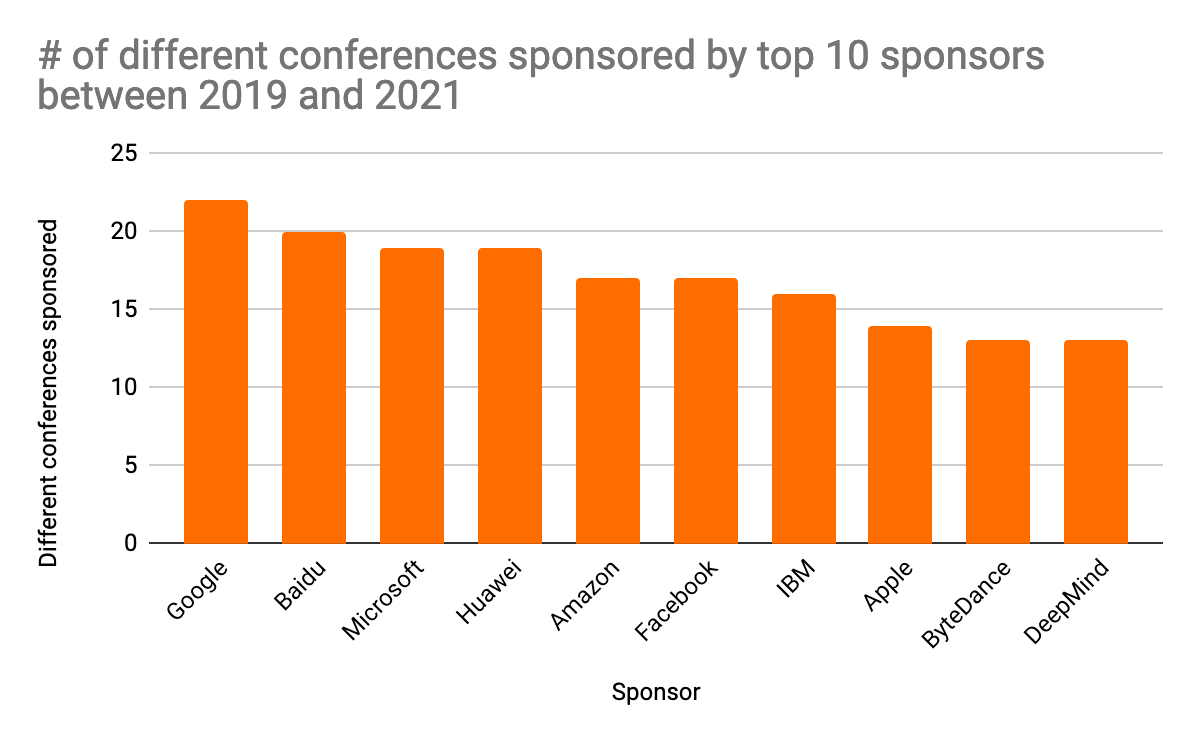
This spreadsheet includes sponsorship facts for the prime 25 most frequent sponsors (2). Of the 10 sponsors who supported the greatest quantities of distinct conferences in the earlier a few several years, 5 are “FAAMG” firms (Fb, Apple, Amazon, Microsoft, Google)—six if you depend DeepMind, a subsidiary of Google’s mum or dad firm Alphabet. No non-gain organizations, government science funding businesses, or sponsors from outside the U.S. or China appeared amongst the leading 10.
General, amid the most recurrent and most generous supporters of the major 25 CS conferences, the only non-tech/non-company donor was the Countrywide Science Foundation, which sponsored five distinctive conferences (11 whole gatherings) with donations generally ranging concerning $15,000 and $25,000.
In addition to getting their firm title and emblem shown on convention advertising resources, prime sponsors (who usually give upwards of $50,000) get benefits such as alternatives to sponsor prizes or pupils grants, complimentary registrations and private conference rooms, obtain to databases of convention registrants interested in recruitment possibilities, digital booths or precedence exhibition areas, marketing opportunities and push guidance, and obtain to attendee metrics on “exhibitor dashboards”. A “Hero Sponsor” who gave $50,000 or much more to the 2021 Conference on Human Elements in Computing Devices (CHI), for example, would have gained 34 different advantages – which cumulatively produce options for steady entry to and influence on attendees all over the celebration.
It is difficult to get an exact estimate of precisely how substantially cash each individual enterprise donates to these conferences, as these figures are not constantly documented to the general public. Some conferences only publish a checklist of supporters with no aspects about how considerably each individual just one gave. Other people assign sponsorship amounts this sort of as “Platinum” or “Diamond”, but the financial value affiliated with each and every stage varies by conference and calendar year. When dollar amounts are furnished, they normally characterize a opportunity range of numerous thousand dollars—for instance, a Platinum Sponsor of the 2021 SIGMOD/PODS conference may well have specified wherever amongst $16,000 and $31,999. On top of that, it is complicated get insight into how accurately these resources are utilized.
Provided the extent of monetary entanglement in between Significant Tech and academia, it could be unrealistic to count on CS scholars to fully resist accepting any market funding—instead, it may well be much more practicable to make a concerted effort and hard work to build greater specifications for and larger transparency pertaining to sponsorship.
In Section 2 of this short article, I will recommend ways that can be taken to decrease the opportunity chilling or agenda-location effects brought on by company funding on CS investigation.
(1) 6 of the prime 25 CS conferences in the globe are organized by ACM, the Association for Computing Machinery. Amongst 2019 and 2021, several of individuals conferences ended up largely funded by American tech businesses like Apple, Amazon, Facebook, Google, IBM, and Microsoft, and Chinese ones like Alibaba, Baidu, ByteDance, and Huawei.
(2) I have compiled a convention sponsorship databases that involves extensive details that is not involved in this spreadsheet. If you are intrigued in examining it, or in collaborating on additional details selection, I would be content to share it privately.
A lot of, a lot of many thanks to Prof. Arvind Narayanan and Karen Rouse for their considerate guidance on and aid with this piece.


More Stories
The Future Unleashed: 10 Tech Innovations That Will Redefine Reality
The Future Unplugged: How AI is Reshaping the Tech Industry
The Future of AI: How Tech Is Reshaping Industries You Never Knew